




“The Strait of Hormuz…I’ve never gone from not knowing a thing existed to talking about it constantly that fast since the air fryer.” – comedian Jimmy Carr
When you hear about madness during the month of March, it might bring to mind visions of college basketball, brackets, and Cinderella teams making a run deep into the tournament. This year the markets experienced a bout of “madness” themselves in the late first and early second quarters, which may have given you a feeling déjà vu from 2025 even though the catalysts were different. Here is a recap of the events that have made an impact on the markets year-to-date:
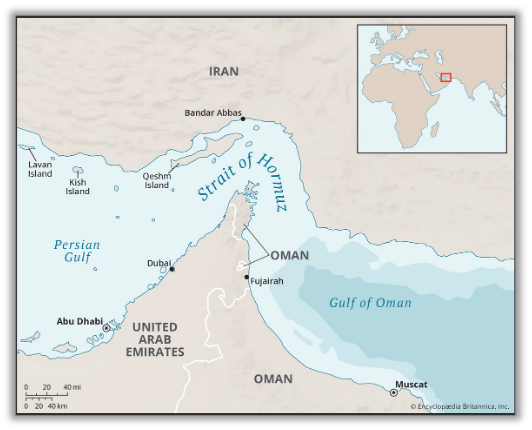
- Conflict in the Middle East: The U.S. and Israel launched joint strikes on Iran and its leadership on February 28th. The subsequent fallout of the conflict rippled through equity, fixed income, and commodities markets across the globe. The Strait of Hormuz, a narrow waterway near the Persian Gulf located between Iran and Oman, is one of the most important trade bottlenecks in the world and has been effectively shut down (map pictured below). Approximately 25% of the world’s maritime oil travels through the strait, along with other important commodities including helium, sulfur, liquid natural gas, and fertilizer inputs. Although a cease-fire has been in effect since April, negotiations are still ongoing with a final agreement to end the war still pending. In the meantime, ship traffic through the strait has been almost non-existent, putting pressure on supplies of the previously mentioned important commodities.
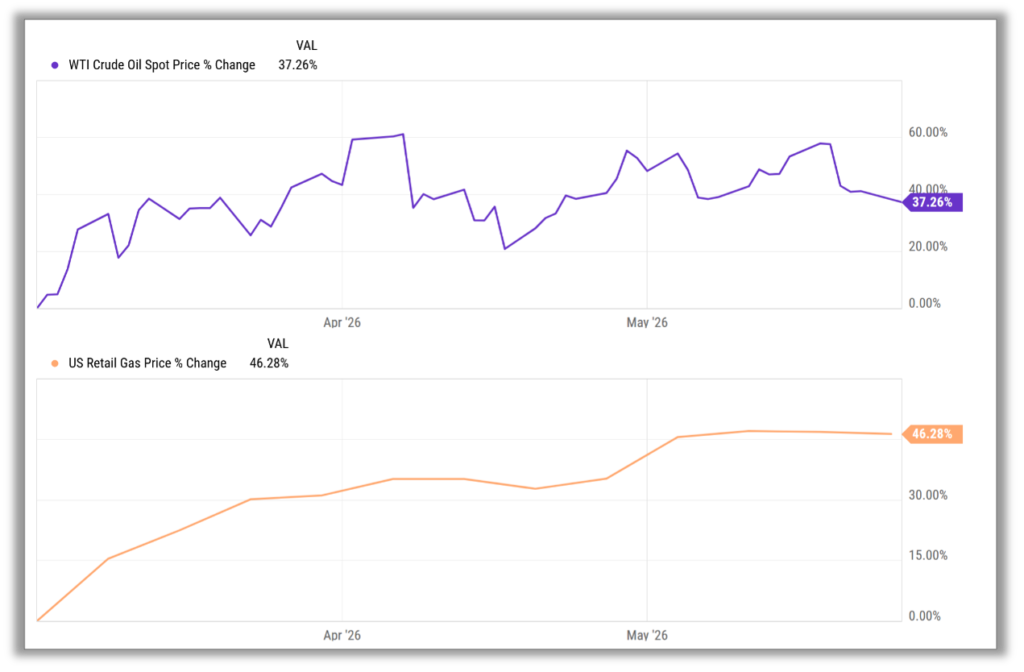
- Oil & Inflation: Oil prices jumped by over 37% and retail gas prices jumped by over 46% over the past 3 months (Chart 1), contributing to upward pressure on inflation. The consumer price index rose 3.3% in March and 3.8% in April on a year-over-year basis. Though the United States is more insulated from energy supply shocks than the EU or Asia because it is a net exporter of oil, it is not immune to second-order effect price impacts across goods & services including fuel, transportation, plastics, chemicals, and food. Since inflation is a lagging indicator, it is likely to remain higher in the near-term even if the Iran war ended immediately, as ship traffic normalization and energy infrastructure repairs in the Middle East will take time.
- Federal Reserve: Kevin Warsh was sworn in as the new chairman of the Federal Reserve in May, replacing Jerome Powell. Mr. Warsh takes the helm of the Fed at an interesting time, as inflation has begun to notch higher due to recent oil & energy price pressures. His proposed changes include having the Fed’s communications be more event-based rather than the current mandatory & periodic schedule, using interest rates as the primary policy tool rather than the Fed’s balance sheet, and a modified focus of the Fed’s price stability mandate by using different data for measurement and focusing on the absolute level of inflation rather than an average level over time. The President has been vocal about his desire for lower interest rates. However, even if the new Chairman agrees he is one vote out of twelve members of the FOMC which decides the Federal Funds rate. It is also worth noting that the Fed Funds rate is a very short-term interest rate target – the Fed does not explicitly set other rates nor Treasury yields, such as the 10-year Treasury rate which influences mortgage rates.
- Tariffs & the Supreme Court: In February, the U.S. Supreme Court ruled that the tariffs President Trump had imposed under the International Emergency Powers Act (IEEPA) were invalid. However, the administration still can (and did) impose tariffs under various other statutes, however they are limited in scope compared to the previous tariffs.
- Consumers & Employment: Consumers continue to spend, though the backdrop of war and an increase in gas prices is weighing on sentiment. Higher than average tax refunds due to the One Big Beautiful Bill Act (OBBBA) have been offset by the increase in prices at the gas pump. U.S. employment is in a steady state, best described as a “no hire, no fire” job market. Business leaders must always operate without a perfect view of the future; however tariffs and recent supply & demand dynamics have contributed to additional clouds of uncertainty which have weighed on hiring & expansion plans. Recent months have shown nascent signs of payroll growth, while the unemployment rate & level of continuing unemployment claims have steadied.
- Businesses & Capital Expenditures: S. corporate revenue growth & earnings growth have been strong. S&P 500 companies have reported earnings growth and revenue growth of 28.6% and 11.8% respectively on a year-over-year basis during Q1 2026, with major contributions from the technology, communication services, materials, and consumer discretionary sectors. U.S. manufacturing output has also quietly been expanding during 2026. Businesses investment has boomed, with companies spending notable amounts on capital expenditures to support the buildout of artificial intelligence (AI) infrastructure. We will expand on the implications of AI for the economy & markets in an upcoming article.
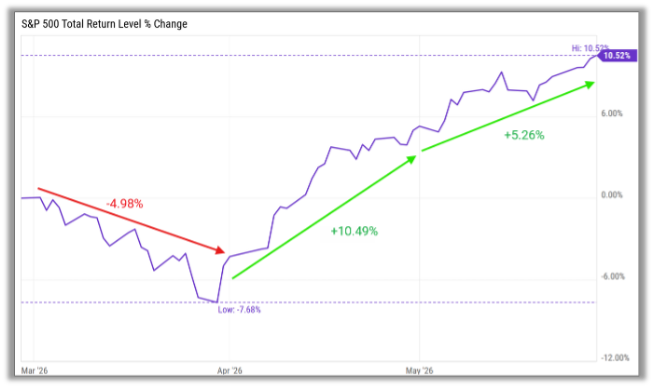
So how did markets react to all these major developments? After a nearly -8% drawdown in March during the fog of war, April’s 10.5% return was the best month for the S&P 500’s return in 5 ½ years and the third-highest monthly performance in the last 10 years. The rally continued in May as the index finished the month with another 5%+ gain (Chart 2). Treasury rates rose because of the impulse from recent inflation pressure, with the 10-year Treasury yield rising from 3.95% to 4.44% over the same 3-month period.
The stock market & the economy appear to have taken shocks over the past three months in stride. Although the impacts from the Middle East conflict are notable and will linger until a final peace agreement is signed, they are not expected to completely derail the current trend of U.S. economic growth.
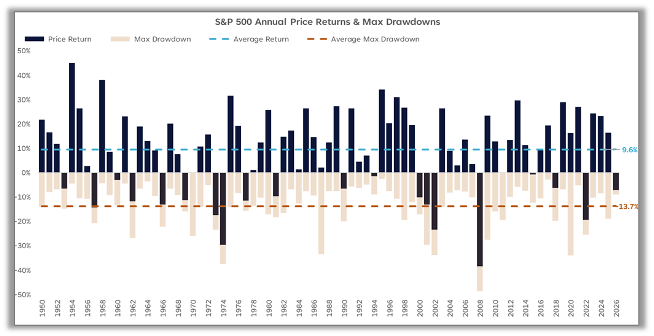
As we have previously detailed (see our article “The Price of Admission”), volatility and drawdowns – whether caused by a war or otherwise – are normal for markets. The average intra-year peak to trough pullback for the S&P 500 index over the past 75 years is approximately -14%, yet the index has posted a positive return in 74% of those calendar years (Chart 3). Markets will always give investors reasons to be excited and reasons to worry. In most areas of life, it makes sense to take significant action to try to solve problems or resolve uncertainty. Investing can feel counterintuitive because often the best course of action is to do the opposite and avoid significant changes to your investment plan, as the U.S. equity markets have reinforced over the past 3 months. Markets are forward-looking and can reverse course quickly from bad to good, as the first parts of 2025 and 2026 have shown.
Disruptions or dislocations offer the chance for our investment department to recalibrate our portfolios, but our underlying plan-based focus & strategy philosophy does not change. The recent equity market turbulence has presented an opportunity to add to areas we believe will add value to our strategies’ risk & return profiles over time. Short duration fixed income offers the opportunity for positive real returns, and the recent rise in interest rates presents an opportunity to increase yield without sacrificing credit quality.
From all of us at MBM, we deeply appreciate your continued trust, loyalty, and support. We hope your summer is off to a great start!

Investment advisory services offered through MBM Wealth Consultants, LLC, a registered investment adviser. Registration does not imply a certain level of skill or training.
Please note – investing involves risk, and past performance is no guarantee of future results. Asset allocation does not ensure a profit or protect against a loss. This material is intended for illustrative purposes only and should not be construed as specific investment or tax advice.
Sources:
- https://www.congress.gov/crs-product/R48903
- https://www.weforum.org/stories/2026/04/beyond-oil-lng-commodities-impacted-closure-hormuz-strait/
- https://on.spdji.com/rs/838-LDP-483/images/dashboard-sp-500-factor-2026-04.pdf
- https://www.yardeniquicktakes.com/warsh-rinse-repeat/
- https://www.lpl.com/research/blog/technical-perspective-on-the-current-drawdown.html
- https://www.lpl.com/research/weekly-market-commentary/energy-shock-expected-to-hit-prices-harder-than-the-economy.html
- https://www.cnbc.com/2026/05/12/inflation-breakdown-for-april-2026-cpi-chart.html
- https://insight.factset.com/analysts-making-largest-increases-in-quarterly-eps-estimates-for-sp-500-companies-since-2021