




“AI is getting smarter every day. That’s good, because pretty soon we’ll need their help to figure out how to use our smartphones.” -Steven Wright
The number and frequency of headlines about artificial intelligence (AI) has increased over the last year as the technological buildout has impacted markets and the economy. AI has the potential to be transformative for businesses and consumers, for the labor market, and for our daily lives in general.
First, let’s define artificial intelligence. Why not go straight to the source and test it out?
Prompt: Define artificial intelligence in 50 words or less.

Answer from Claude (Anthropic’s AI assistant): Artificial intelligence is the field of computer science focused on building systems that perform tasks normally requiring human intelligence, such as learning from data, recognizing patterns, understanding language, reasoning, solving problems, and making decisions. Modern AI often relies on machine learning, where systems improve through experience rather than explicit programming.
The AI debate has reached the highest levels of government, with President Trump hosting a summit with technology CEOs and industry leaders, a White House task force being formed to evaluate opportunities and risks from AI, and bi-partisan regulation being drafted in the Senate – all in the past month. The range of possible outcomes from AI progress and adoption is extremely wide, with predictions ranging from worst case dystopian scenarios to technological utopia.
Recent doom-and-gloom headlines about recent AI security concerns and potential catastrophic outcomes for either the job market or society at large tend to garner more attention and engagement because humans are wired for survival. A cynic would point out that some of the alarmists with ties to the leading AI model labs may be seeking to generate support for regulation to protect their competitive moats, achieve regulatory capture, and close the door behind them to prevent additional competition. AI development, testing, and regulation are important topics that will benefit from continued discussion and debate in the public arena. But negative headlines ignore the potential very positive scenarios – advances in science & medicine, commerce, productivity, and general quality of life.
Markets, Economy, & Employment
If you’ve held any broad-based equity exposure in your portfolio, you have benefitted from the AI buildout & investment over the past few years. Capital expenditures and business investment have been important contributors to recent economic growth and subsequently market returns. This is not just a U.S. phenomenon – the weight of the technology sector in public equity markets worldwide has notably increased.
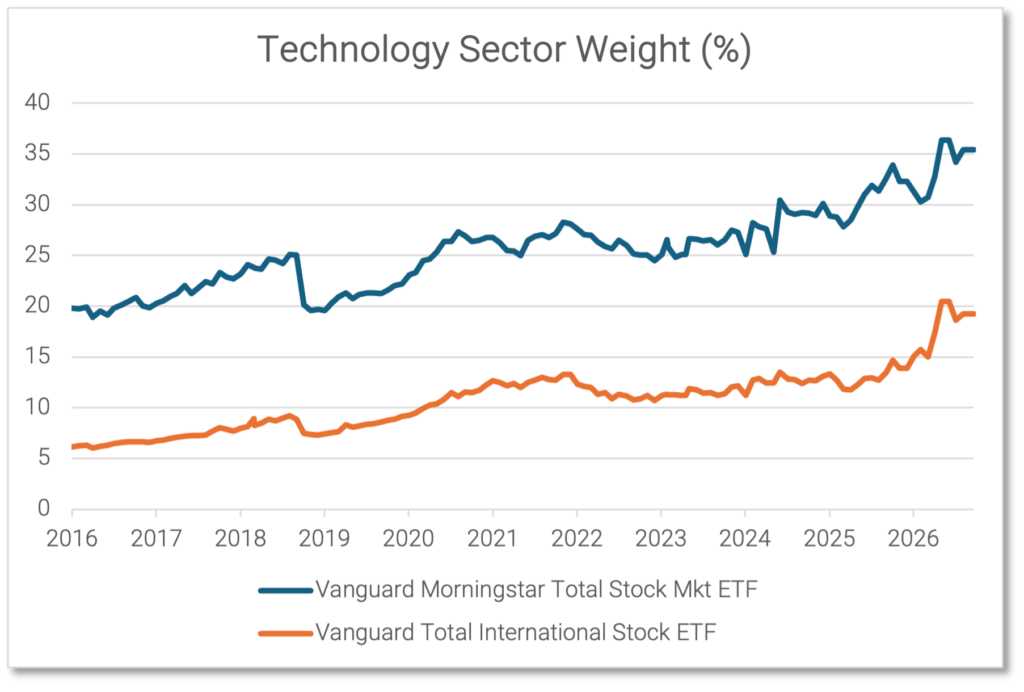
Doomsayers tend to point out possible similarities between the dot-com bubble and today’s market environment while failing to highlight important differences, such as current earnings & profitability and a more balanced supply & demand dynamic. Market bubbles are easy to identify in hindsight, but nearly impossible to predict. Bubbles represent extremes in unsustainable market fundamentals, not normal market cycles which have occurred throughout time. The ultimate winners as well as the size and speed of the transformation from investment to revenues & earnings are unknowable, however recent data show the trend of revenue growth and return on investment continuing to strengthen.
AI’s broader impact on the future economy and markets has yet to be determined. Joe Davis, Chief Economist for Vanguard, offers relevant considerations on the potential outcomes in his recent book:
- Technologies introduced since the 1970’s have been more incremental than those introduced earlier. As an example, consider the comparison between the introduction of plumbing vs. the smartphone.
- Widespread adoption of a new technology does not automatically lead to significantly higher economic growth and prosperity. If the technology leads to innovation across work and everyday life and allows for the development of new products and businesses, the impact on growth will be much greater. As an example, consider social media – ubiquitous, but not as economically transformative as the introduction of electricity.
- When a large shift in prevailing trends occurs, it can be abrupt and significant. For example, the decades of the 1920s, 1950s, and 1990s were periods of rapid innovation and disruption, rather than minor economic growth episodes.
- Stock market leadership can morph during technological revolutions. Research shows in past cycles, gains tend to concentrate within established leaders before diffusing more broadly. For example, electrification in the 1920s propelled growth in the manufacturing and transportation sectors. Computing and telecommunications advancements in the 1990s greatly benefited healthcare and financial companies.
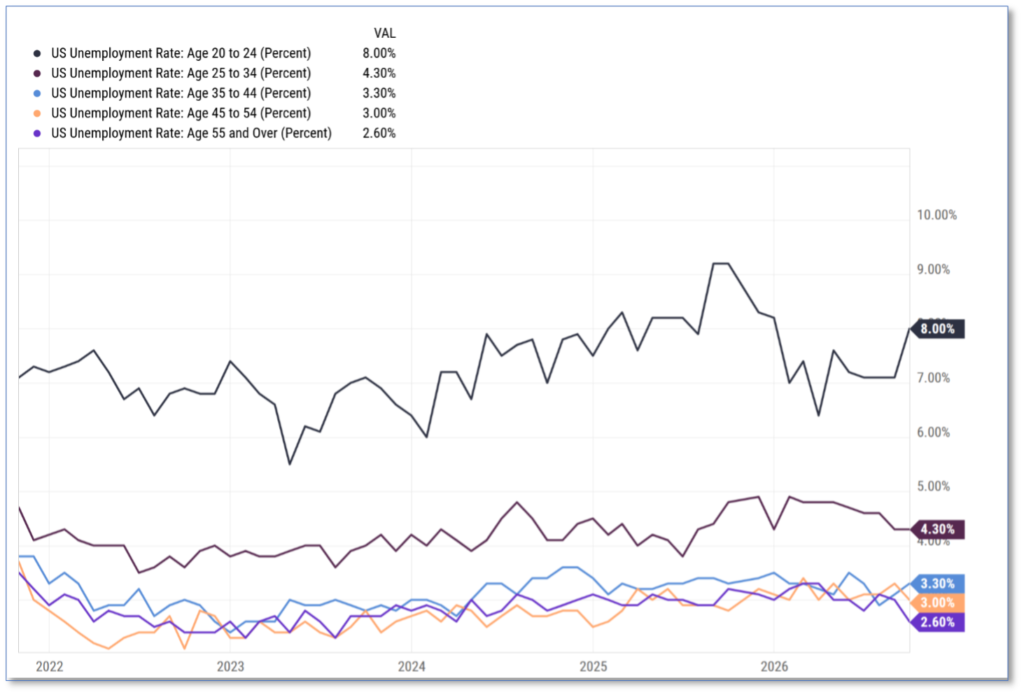
On the employment front, to date, massive disruption in the job market has not occurred. History shows previous predictions of a job apocalypse due to new technologies have been incorrect. Although many recent college graduates may approach their upcoming first post-college job market with trepidation, a recent study focused on the 2026 job market did not find high levels of widespread impact from AI as of yet. Technological progress has generally led to a shift in the roles & responsibilities of existing jobs or the composition of the workforce over time, rather than massive reductions in total employment. Advancements in farming technology shifted agricultural jobs to other industries but did not eliminate farmers. The invention of the spreadsheet decreased the number of bookkeepers, but the number of accounts and financial analysts grew.
Unemployment Rate by Age Groups
Portfolio Considerations
Given the wide range of outcomes and an uncertain future, what actions can investors take? Thankfully, evergreen successful investing principles should suit investors well:
- Diversification:
- The stock market will always have winners and losers over time as technologies, trends, and economies change. Within equities, having diversified exposure to the technology leaders of today as well as potential beneficiaries of tomorrow offers balance that is not dependent on a single future outcome for success.
- High credit quality fixed income offers yield levels that investors have not seen for over a decade, which should offer value in a range of economic scenarios.
- Planning:
- Your financial plan drives your portfolio, not vice versa. Your unique goals define the risk and reward calibration within your investments – the investments are meant to serve the purpose of achieving your goals.
- Knowing what you own and why is good portfolio hygiene regardless of the market environment but is especially helpful in a future with a wide possibility of outcomes. MBM considers portfolio exposures, risk, and return opportunities not just at the surface level but also “under the hood” in our investment strategies for clients.
Afterword From Matt Westhoff, CEO
Over the next three to five years, financial planning firms that embrace AI will look very different from those that resist it. We are navigating this rapidly changing landscape with a dual mandate: use AI to improve the quality of our service and advice while safeguarding client data. To help chart the right path for our clients, we employ a full-time technology expert and work with outside consultants. AI is not intended to replace experts; it should help them work more efficiently. Just as important, we remain committed to the personal touch that has defined our firm for 17 years. AI will not replace that. As always, we appreciate your continued trust and confidence.

Investment advisory services offered through MBM Wealth Consultants, LLC, a registered investment adviser. Registration does not imply a certain level of skill or training.
Please note – investing involves risk, and past performance is no guarantee of future results. Asset allocation does not ensure a profit or protect against a loss. This material is intended for illustrative purposes only and should not be construed as specific investment or tax advice.
Sources:
- https://www.wsj.com/tech/ai/trump-defends-light-touch-ai-strategy-after-industry-sounds-alarms-2f9599eb
- https://www.wsj.com/tech/ai/new-ai-task-force-to-report-on-risks-of-technology-after-public-and-industry-concerns-b6308bef
- https://pmc.ncbi.nlm.nih.gov/articles/PMC10202797/
- https://www.wsj.com/economy/jobs/tech-has-never-caused-a-job-apocalypse-dont-bet-on-it-now-d192b579
- https://papers.ssrn.com/sol3/papers.cfm?abstract_id=7502823
- https://www.schroders.com/en-us/us/institutional/insights/august-2026-early-signs-of-ai-return-on-investment-/
- Coming Into View: How AI and Other Megatrends Will Shape Your Investments, Joesph H. Davis, PhD – Vanguard Global Chief Economist